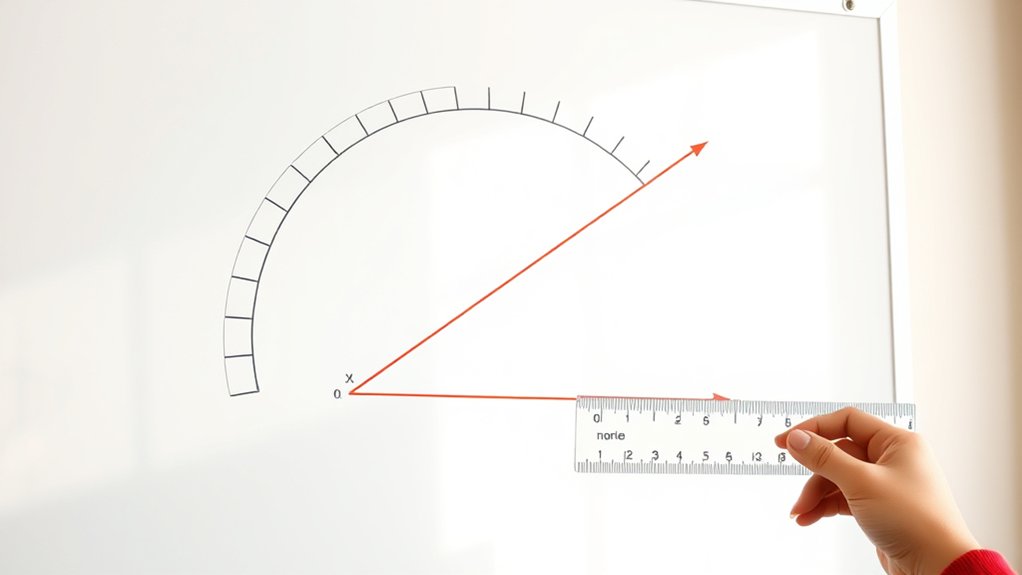
How Do You Find The Supplement Of An Angle Step by Step
To find the supplement of an angle, subtract its measure from 180°. For example, if the angle is 70°, you calculate 180° – 70°, which gives you 110°. This works for both adjacent angles that form a straight line and non-adjacent angles adding up to 180°.
Be sure your original angle is less than 180° before starting. If you keep exploring, you’ll understand how supplements apply to different geometric shapes and solve real-world problems. It’s pretty interesting once you see how it all fits together!
Understanding the Supplement of an Angle
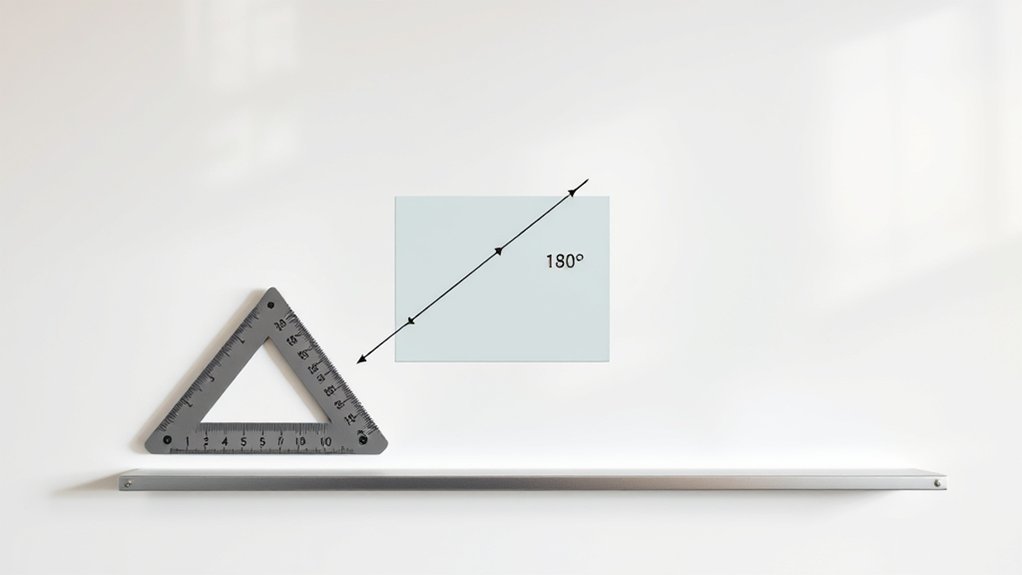
The supplement of an angle is the angle that, when added to the original angle, totals 180°. When you work with supplementary angles, you’re dealing with two angles whose measures always add up to 180°. These angles can be adjacent, sharing a common side, or non-adjacent, positioned apart from each other.
Supplementary angles always add up to 180°, whether they share a side or are separate.
Understanding this relationship is essential because supplementary angles often appear in linear pairs and various geometric figures. For example, if one angle measures 120°, its supplementary angle must be 60°, since together they form 180°.
Knowing this helps you recognize and work with complementary shapes and solve related problems efficiently.
Mastering the concept of supplementary angles lays the groundwork for more advanced geometry tasks you’ll encounter later. It’s a key idea that makes other concepts easier to understand as you go along.
How to Calculate an Angle’s Supplement
Calculating an angle’s supplement is straightforward once you know the simple formula: subtract the angle’s measure from 180°. To find the supplement, take the given angle’s degree measure and subtract it from 180°.
For example, if you have an angle measuring 120°, its supplement is 180° minus 120°, which equals 60°. Remember, supplementary angles always add up to 180°, whether they’re adjacent or not.
This relationship is essential when solving problems involving angles on a straight line or linear pairs.
After calculating, double-check that the sum of your angle and its supplement equals 180° to confirm accuracy. By following this method, you can quickly and confidently find the supplement of any angle you encounter.
Formula for Finding an Angle’s Supplement

Once you know the measure of an angle, you can quickly find its supplement by using the formula b = 180° – a, where a represents the given angle’s degree. This formula works because the sum of an angle and its supplement always equals 180°.
To find the supplement, simply subtract the measure of the given angle from 180°.
For example, if the angle measures 120°, you find the supplement by calculating 180° – 120° = 60°. This straightforward method helps you solve problems involving linear pairs and geometry.
Keep in mind, the supplement you find may be adjacent or non-adjacent to the original angle, but the formula remains the same. Using this formula, you’ll confidently find the supplement every time.
Identifying Supplementary Angles in Diagrams
When you examine a diagram, you can identify supplementary angles by looking for pairs that form a straight line, meaning their measures add up to 180°. Look for angles sharing a vertex and a side, as these adjacent angles often indicate supplementary angles. Label the angles clearly using notation like m∠A + m∠B = 180° to express their relationship.
If the diagram shows angle measures, you can quickly find a supplement by subtracting the given angle from 180°. Remember, supplementary angles aren’t always adjacent; sometimes, non-adjacent angles sum to 180°. You can usually figure this out from the diagram’s context or other angle relationships.
Finding Supplements for Adjacent and Non-Adjacent Angles

You can find the supplement of an angle by simply subtracting its measure from 180°.
Now, when it comes to adjacent supplementary angles, keep in mind that they share a vertex and form a straight line together.
On the other hand, non-adjacent supplementary angles also add up to 180°, but they don’t have to touch each other.
Adjacent Supplementary Angle Properties
Although supplementary angles always add up to 180°, adjacent supplementary angles share a common vertex and side, forming a straight line together. This means the two angles are directly next to each other, creating what’s called a linear pair.
To find the supplement of one angle in this pair, simply subtract its measure from 180° using the formula b = 180° – a. For example, if one angle measures 120°, its adjacent supplementary angle will be 60°.
Understanding these adjacent supplementary angle properties helps you solve problems involving linear pairs and various geometric setups.
Non-Adjacent Supplementary Angle Examples
Since supplementary angles always add up to 180°, you can find the supplement of any angle by subtracting its measure from 180°. This applies not only to adjacent angles but also to non-adjacent supplementary angles.
For example, angles measuring 100° and 80° are supplementary even though they aren’t next to each other. They don’t share a common vertex or side but still add up to 180°.
To find the supplement of a given angle, use the formula: supplement = 180° − angle.
Understanding non-adjacent supplementary angles helps you solve geometry problems involving polygons and various angle relationships.
Calculating Supplement Angles Methods
Calculating the supplement of an angle involves a straightforward subtraction from 180°. To find the supplement of an angle, subtract the given angle’s measure from 180° using the formula b = 180° – a.
For example, if you have an angle measuring 120°, its supplement is 60° (180° – 120° = 60°). This method applies to both adjacent and non-adjacent angles.
Adjacent supplementary angles share a side and vertex, forming a straight line, while non-adjacent supplementary angles aren’t connected but still sum to 180°. In a linear pair, if one angle is 45°, its supplement is 135° (180° – 45° = 135°).
Mastering these methods helps you quickly find the supplement of an angle in various geometric problems. It’s a handy skill that makes solving these problems much easier.
Finding the Supplement When You Know One Angle
When you know one angle, finding its supplement is pretty straightforward.
All you have to do is subtract that angle from 180°.
You can use the formula b = 180° – a to quickly calculate the missing angle.
Let’s try applying this method to some examples so you can see how it works in practice.
Understanding Supplement Definition
An angle’s supplement is the amount you need to add to it to reach 180°. When two angles are supplementary, their measures sum up to 180°. This means you can find one angle’s supplement by subtracting its measure from 180°.
For example, if an angle measures 120°, its supplement is 180° – 120° = 60°. Understanding this concept is essential in geometry and solving problems involving linear pairs.
Keep in mind:
- Supplementary angles always add up to 180°.
- Finding a supplement helps solve unknown angles quickly.
- It’s key to understanding the relationship between adjacent angles.
- You can use subtraction to find any supplement once one angle is known.
Grasping the supplementary angle concept lays a solid foundation for further geometry topics. It’s definitely a handy tool to have in your math toolkit!
Using The Supplement Formula
If you know one angle, you can quickly find its supplement using a simple formula: subtract the known angle from 180°. This works because supplementary angles always add up to 180°.
To find the supplement of an angle (a), use the formula b = 180° – a, where b is the supplement. For example, if the angle measures 120°, subtracting it from 180° gives you 60°, the supplement.
This method applies to any angle less than 180°, whether acute, obtuse, or straight.
Solving Supplement Examples
How do you find the supplement of an angle when you already know its measure? It’s simple: subtract the given angle from 180°. This works because supplementary angles always add up to 180°.
For example, if one angle is 75°, its supplement is 105° (180° – 75°).
Here’s how you can solve similar problems quickly:
Identify the known angle measure.
Use the formula: supplement = 180° – known angle.
Calculate the difference to find the supplementary angle.
Common Mistakes in Finding Angle Supplements
When working with supplementary angles, you’ll often run into common mistakes that can throw off your calculations. One frequent error is forgetting that supplementary angles must add up to exactly 180°, not more or less.
Don’t assume only adjacent angles are supplementary. Non-adjacent ones work too if their measures total 180°.
Another common mistake is setting up the equation incorrectly. Always identify the given angle’s measure before writing something like m∠A + x = 180°.
Remember to subtract the known angle from 180° to find its supplement.
Finally, avoid confusing complementary and supplementary angles. Complementary sum to 90°, while supplementary sum to 180°.
Staying mindful of these common mistakes will help you find angle supplements accurately every time.
Solving Real-World Problems Using Supplementary Angles
Now that you understand common mistakes in finding supplementary angles, you can apply this knowledge to solve real-world problems. Supplementary angles play an essential role in design, construction, and navigation.
Whenever two angles add up to 180°, you can find the missing angle by subtracting the known one from 180°. This helps guarantee accuracy and stability in practical situations.
Consider these examples where supplementary angles matter:
- Designing triangular roof structures with precise angles
- Calculating angles in navigation routes
- Making sure walls and beams meet at straight lines for stability
- Verifying angles in machinery and equipment assembly
How to Check Your Work When Calculating Supplements
When you calculate a supplement, just remember to use the formula b = 180° – a to find the missing angle.
After that, it’s a good idea to double-check your work by adding the original angle and its supplement together. If they total 180°, you know your answer is spot on.
This simple step helps catch any mistakes and gives you confidence that your calculation is correct.
Verify Angle Sum
Because verifying your answer assures accuracy, you should always check that the sum of the original angle and its supplement equals 180°. This step guarantees your calculation is correct and helps avoid mistakes, especially when working with complementary angles or other angle relationships.
To verify your angle sum, follow these steps:
- Add the original angle and its supplement together.
- Confirm the total equals exactly 180°.
- If the sum is off, revisit your subtraction from 180°.
Use Supplement Formula
Although finding the supplement of an angle might seem straightforward, using the supplement formula helps you calculate it quickly and check your work. The formula is simple: b = 180° – a, where a is the given angle, and b is its supplementary angle.
For example, if a is 75°, then b equals 180° – 75°, which is 105°. This formula assures the two angles add up to 180°, confirming they’re supplementary.
When you use this formula, you can easily find an angle’s supplement and verify your results. Practice with different values for a to build confidence in applying the formula accurately.
This method guarantees you calculate supplementary angles correctly every time. Give it a try, and you’ll see how quick and reliable it is!
Double Check Calculations
Double checking your calculations is essential to confirm you’ve found the correct supplement of an angle. When you subtract the angle from 180° using the formula ( b = 180° – a ), errors can happen. To avoid mistakes, always double check calculations by verifying that the sum of the original angle and its supplement equals 180°.
Remember, angles greater than 180° don’t have supplements.
Here’s how to double check calculations effectively:
Recalculate the subtraction carefully to catch simple errors.
Add the original angle and your supplement result to confirm they total 180°.
Use a calculator for complex angles or when unsure.
Also, verify the original angle is less than 180° before proceeding.
Why Understanding Angle Supplements Matters in Geometry
When you grasp how angle supplements work, you access a key tool for solving many geometry problems involving straight lines and linear pairs. Supplementary angles always add up to 180°, helping you find unknown angles quickly.
You’ll see this concept often when analyzing triangles, polygons, and problems with parallel lines and transversals.
Remember, supplementary angles don’t have to be adjacent, so you can identify relationships between angles that aren’t next to each other. Understanding supplementary angles sharpens your reasoning skills, which is essential for tackling proofs and more advanced geometry topics.
Mastering this concept lays a solid foundation, making it easier for you to approach complex problems with confidence and accuracy.
Frequently Asked Questions
Can Supplements Be Negative Angles?
No, supplements can’t be negative angles. When you find a supplement, you subtract the angle from 180°, and the result must be between 0° and 180°.
If you get a negative angle, it means the original angle was over 180°, which isn’t valid for supplementary angles.
Are All Straight Lines 180 Degrees?
Yes, all straight lines measure exactly 180 degrees. When you look at angle relationships, a straight line forms a straight angle, which is always 180 degrees.
This means if you have two adjacent angles on that line, their measures add up to 180 degrees, making them supplementary.
How Do Supplements Relate to Complementary Angles?
When it comes to angle relationships, supplements and complements go hand in hand but aren’t interchangeable. You’ll find that supplementary angles add up to 180°, forming a straight line, while complementary angles total 90°, often creating right angles.
Understanding these differences helps you solve geometry problems accurately.
Each pair plays a unique role in angle relationships. Keep this in your toolkit, and you’ll never miss the forest for the trees.
Can Angles Greater Than 180 Degrees Have Supplements?
Angles greater than 180 degrees don’t have supplements in the traditional sense because supplements are based on angle relationships that sum to 180°.
If you try to find a supplement for a reflex angle, you’ll get a negative value, which isn’t a valid angle measure.
Do Supplements Apply in Three-Dimensional Geometry?
Yes, supplementary relationships do apply in three-dimensional geometry. When you work with angles formed by intersecting lines or planes, you’ll find pairs that add up to 180°. These supplementary angles help you understand spatial orientation.
For instance, at vertices or between dihedral angles, identifying these relationships allows you to analyze how objects align or interact in space.
This makes supplementary relationships essential in 3D geometric reasoning.
Conclusion
Now that you know how to find an angle’s supplement, you can easily solve many geometry problems with confidence. Remember, the supplement adds up to 180 degrees, so just subtract the given angle from 180.
Isn’t it satisfying to reveal this simple step and see how it applies to real-world situations? Keep practicing, and you’ll quickly spot supplementary angles in any diagram or problem you encounter.