How To Take Vitamin D Supplement ? A Complete Beginner Guide
You should take your vitamin D supplement daily with a meal containing healthy fats like avocado or olive oil. This can boost absorption by up to 50%. Morning doses help maintain steady blood levels and may avoid sleep disruption.
Adults generally need 400 to 800 IU, depending on age. D3 is preferred for better effectiveness. Regular blood tests guarantee safe levels and help avoid overdose risks.
Keep going to explore timing, dosage, and safety details that optimize your vitamin D benefits.
Why You Need a Vitamin D Supplement

Because vitamin D plays a critical role in calcium absorption and bone health, you need to guarantee you get enough to prevent deficiencies linked to conditions like osteoporosis and rickets.
Vitamin D deficiency affects around 42% of U.S. adults, particularly older adults and those with limited sun exposure, making supplements essential.
Natural food sources are scarce, so relying on fortified foods or supplements helps you meet the recommended daily amount. For adults, this daily amount is generally 600 IU, increasing to 800 IU for older adults to support overall health.
Since vitamin D supports calcium absorption, maintaining adequate levels through supplements assures your bones stay strong and reduces the risk of chronic health issues associated with deficiency.
It’s a simple step that can make a big difference in your long-term health.
How Much Vitamin D Should You Take Daily?
Guaranteeing you get the right amount of vitamin D daily is key to supporting your bone health and overall well-being.
For adults and children over one year, the recommended amounts are 10 micrograms (400 IU) per day, while adults aged 70 and older should aim for 20 micrograms (800 IU).
Infants need slightly less, between 8.5 to 10 micrograms daily. Maintaining blood levels of at least 20 ng/mL (50 nmol/L) helps guarantee sufficient levels.
High-risk individuals, such as those with limited sun exposure or darker skin, may need to take vitamin D supplements year-round to meet their daily intake.
Monitoring your intake and blood levels can help you avoid deficiency and optimize your vitamin D status effectively.
Vitamin D2 vs. D3: Which Supplement Is Best?
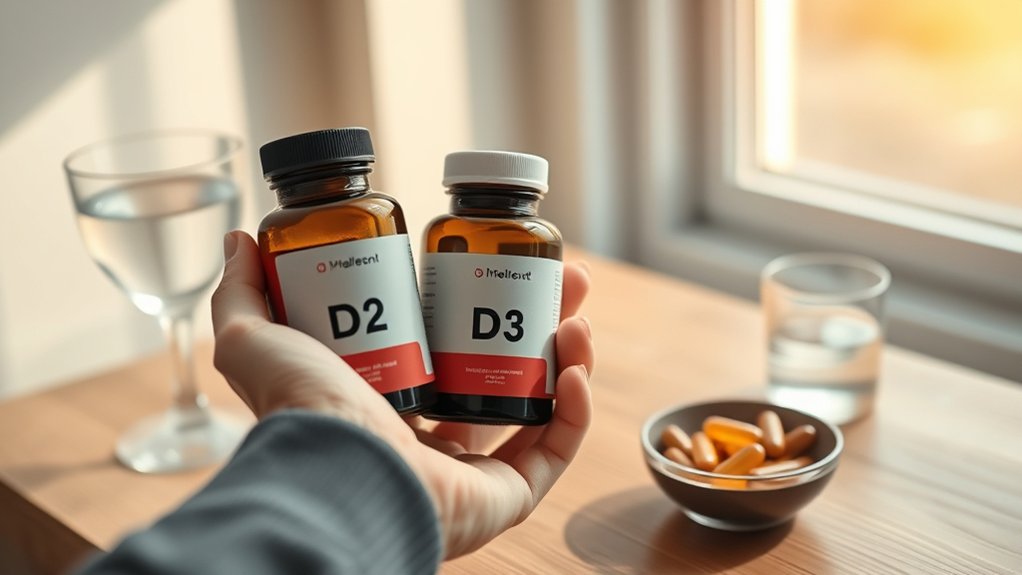
You’ll find two main types of vitamin D supplements: D2 and D3. D2 comes from plants, while D3 is usually derived from animal sources.
Research shows that D3 tends to be more effective at raising and keeping your vitamin D levels steady, especially if you take it with a meal that has some fat in it.
Differences Between D2 and D3
When choosing between Vitamin D2 and D3 supplements, it’s important to understand their differences in sources and effectiveness.
Vitamin D2 comes from yeast and plants, while Vitamin D3 is derived from animal sources like fish liver oil and lanolin. This difference impacts their efficacy and health benefits.
Vitamin D3 is more effective at raising and maintaining serum levels due to its superior absorption rates and longer half-life. Although the recommended dosage is similar for both, D3 generally offers better results.
If you follow a vegan diet, you might prefer Vitamin D2 or vegan D3 from lichen.
Key differences include:
- Vitamin D2 is plant-based; D3 is animal-based
- D3 raises serum levels more effectively
- D3 has higher absorption rates
- Both share similar recommended dosages
- Vegan D3 options exist for plant-based diets
Absorption and Effectiveness
Although both Vitamin D2 and D3 are fat-soluble and absorb better with dietary fats, Vitamin D3 generally outperforms D2 in raising and maintaining serum 25(OH)D levels.
Vitamin D3’s absorption is more efficient, leading to approximately 50% higher increases in serum 25(OH)D compared to equivalent dosages of D2.
When you take Vitamin D supplements, including dietary fats enhances their fat-soluble absorption, maximizing effectiveness.
Typical Vitamin D3 dosages range from 400 IU up to 10,000 IU, but higher amounts should be monitored medically to avoid toxicity.
After starting supplementation, regularly testing your serum 25(OH)D levels helps guarantee you maintain ideal vitamin D status and effectiveness.
Understanding these factors will guide you in achieving better outcomes with Vitamin D3 supplementation.
Choosing the Right Form
Understanding how different forms of vitamin D perform in your body can help you make informed choices about supplementation.
Vitamin D supplements come mainly as D2 and D3, but D3 is more effective at raising and maintaining serum vitamin D levels. It’s better absorbed and lasts longer in your system, making it ideal for long-term supplementation.
While D2 can prevent deficiency, D3 is generally preferred. Before starting, consult your healthcare provider to determine the right form and dosage based on your health needs.
- Vitamin D2 is plant-based, sourced from yeast
- Vitamin D3 comes from lanolin or lichen
- D3 raises serum vitamin D levels more efficiently
- D3 has superior absorption and longer action
- Healthcare providers can tailor dosage and form for you
When Is the Best Time to Take Vitamin D?
You should take vitamin D with meals that contain fats because it can boost absorption by up to 50%.
There isn’t a clear winner between morning or evening when it comes to timing, but keeping it consistent helps maintain steady levels.
Some studies even suggest that taking it in the evening might affect your sleep, so for many people, morning could be the better choice.
Optimal Absorption Timing
Since vitamin D is fat-soluble, taking it with meals that contain dietary fats can boost its absorption by up to 50%. For best absorption timing, aim to take vitamin D with a main meal or a snack rich in fats, like eggs or full-fat dairy.
Consistency in timing matters more than the exact hour you take it, helping maintain steady vitamin D levels.
Be mindful that taking vitamin D late might affect sleep quality, though evidence is still emerging. To guarantee your dosage is effective, regular testing of vitamin D levels is essential.
- Take vitamin D with dietary fats for better absorption
- Maintain consistency in timing daily
- Prefer breakfast or light fat-containing snacks
- Monitor vitamin D levels through regular testing
- Avoid late-night dosing to potentially protect sleep quality
Morning Vs Evening
When should you take your vitamin D supplement, morning or evening? Studies show vitamin D absorption improves a lot when taken with meals containing fat, no matter the time of day. So, it’s really about what you eat with it.
The best time to take your daily vitamin D depends more on being consistent than on the exact hour. Some people say taking it in the evening might mess with sleep, but the evidence isn’t clear, and everyone reacts differently.
The key is to build a routine, whether it’s with breakfast or a light evening snack. This helps you stick with it and supports your overall health. Just make sure to take your supplement with a meal that has some fat to boost absorption and keep your vitamin D levels steady.
In the end, regular and consistent intake is what really matters to get the full benefits of your daily vitamin D for good health.
Why Taking Vitamin D With Food Matters
Although vitamin D is essential for your health, taking it without food can limit its effectiveness. Since vitamin D is fat-soluble, its absorption greatly improves when taken with meals containing healthy fats. Studies reveal that absorption can increase by up to 50% compared to taking it on an empty stomach.
Consuming vitamin D alongside nutrient-rich foods guarantees better nutrient uptake and helps maintain consistent blood levels over time. It’s a simple way to make sure your body gets the most out of your supplement. Establishing a routine by taking vitamin D with meals is especially important if you’re at risk of deficiency.
- Vitamin D requires dietary fat for ideal absorption
- Taking supplements with main meals enhances absorption
- Healthy fats like nuts and avocados support nutrient uptake
- Food presence stabilizes blood levels of vitamin D
- Routine intake with meals helps prevent deficiency
How Dietary Fats Boost Vitamin D Absorption
Since vitamin D is fat-soluble, you actually absorb it much better when you take it with dietary fats.
Research shows that if you consume vitamin D with at least 10 grams of fat—things like butter, nuts, or eggs—it can boost your blood levels by up to 50% within just a few hours.
Importance Of Dietary Fats
Dietary fats play an essential role in boosting vitamin D absorption because vitamin D is fat-soluble. This means your body absorbs it more effectively when it’s consumed with fat.
Studies show that taking vitamin D supplements alongside a high-fat meal can increase absorption by up to 50%, with significant improvements lasting 12 hours.
Including dietary fats not only optimizes vitamin D uptake but also supports overall health by enhancing nutrient absorption.
To maximize the benefits of your vitamin D supplement, consider these sources of healthy fats:
- Butter
- Nuts
- Seeds
- Full-fat dairy
- Eggs
Incorporating these fats into your meals guarantees better vitamin D absorption and contributes to your overall health and wellbeing.
It’s a simple tweak that can make a big difference!
Fat-Soluble Vitamin Absorption
Vitamin D’s fat-soluble nature means your body absorbs it far more efficiently when taken with dietary fats. As a fat-soluble vitamin, vitamin D requires dietary fats to enhance its absorption and increase bioavailability.
Research shows that consuming vitamin D supplements with a meal containing fats can boost serum vitamin D levels by up to 50% compared to fasting.
Furthermore, meals higher in fat content can improve vitamin D absorption by 32% within 12 hours. This underscores the importance of pairing your vitamin D intake with dietary fats to maximize its effectiveness.
When you take vitamin D supplements alongside meals that include fats, you guarantee your body can better absorb and utilize this essential nutrient.
Best Foods To Pair
Taking your vitamin D supplement with fats can greatly improve how well your body absorbs it. Since vitamin D is fat-soluble, pairing it with fatty foods enhances absorption, leading to increased blood levels and better bone health.
Studies show that consuming vitamin D supplements with healthy fats can boost absorption by up to 50%. This supports overall wellness more effectively than taking supplements alone.
To maximize benefits, include these fatty foods in your meals when you take vitamin D:
- Avocados
- Nuts and seeds
- Fatty fish (salmon, mackerel)
- Olive oil
- Full-fat dairy products
Including these healthy fats helps your body soak up vitamin D better. That way, your supplements contribute efficiently to bone health and overall wellness.
How to Build a Daily Vitamin D Routine
Establishing a daily routine for your supplement can greatly improve its effectiveness and your consistency.
When taking vitamin D supplementation, aim to take your dose with a meal containing healthy fats to enhance absorption in the gut. This can increase blood levels by up to 50%.
Consistency is key. Try to take your vitamin D supplement at the same time each day, preferably in the morning, to build a daily vitamin D routine that sticks.
For those with limited sun exposure, following the recommended amounts of vitamin D, such as 10 mcg (400 IU) during autumn and winter, helps maintain adequate levels.
Use reminders or a pillbox to avoid missed doses.
Also, regularly monitor your vitamin D levels through blood tests.
And don’t forget to consult your healthcare professional to adjust your intake as needed.
Signs of Vitamin D Overdose to Watch For
Although vitamin D is essential for health, too much can lead to serious complications. Taking a vitamin D overdose can cause symptoms linked to hypercalcemia, where calcium levels in your blood rise dangerously. Recognizing these signs early helps prevent severe health complications like kidney damage.
Watch for these symptoms of vitamin D overdose:
- Nausea, vomiting, and loss of appetite
- Muscle weakness and confusion
- Frequent urination and dehydration
- Kidney stones and potential kidney failure
- Irregular heart rhythms
Consistently exceeding the recommended daily dose, especially above 4,000 IU, increases your risk.
How to Safely Monitor Your Vitamin D Levels
Because vitamin D levels can vary widely based on factors like diet, sun exposure, and supplementation, regular blood tests are essential to confirm your serum 25(OH)D stays within the ideal range.
Monitoring usually means testing every 3-4 months after you start supplementation. This is especially important if you use high doses or have a diagnosed deficiency.
Testing every 3-4 months is key after starting supplementation, especially with high doses or deficiency.
Work closely with a healthcare professional to figure out the right dosage and how often you should get tested based on your health needs.
If you notice symptoms of deficiency such as fatigue, bone pain, or muscle weakness, get tested promptly to avoid complications. Consistent monitoring helps make sure your supplementation is working and prevents toxicity.
Vitamin D and Medication Interactions You Should Know
When you take vitamin D supplements alongside certain medications, you might notice changes in how well the supplement works or how your body processes it. Medication interactions can affect vitamin D absorption, metabolism, and blood levels. This could potentially change its benefits.
For example, anticonvulsants may reduce vitamin D’s effectiveness, so it’s important to monitor this carefully. Some drugs can also impact cholesterol management, where vitamin D plays a role.
Key medication interactions to know include:
- Statins may influence vitamin D’s effect on cholesterol.
- Bile acid sequestrants like cholestyramine can reduce vitamin D absorption.
- Antibiotics such as rifampin affect vitamin D metabolism.
- Anticonvulsants decrease vitamin D blood levels.
Regular monitoring through blood tests helps you adjust supplementation safely. Staying informed guarantees you get the most out of vitamin D while managing your medications well.
Frequently Asked Questions
Can Vitamin D Supplements Help Improve Mood or Mental Health?
Yes, vitamin D supplements can support mood enhancement and mental health, especially if you have deficiency symptoms.
Since low vitamin D links to seasonal affective disorder and depression, supplementing can improve your mood.
Remember, vitamin D sources include sunlight exposure and diet, but absorption factors vary.
Follow dosage recommendations to optimize benefits.
If you struggle with mental health, consider checking your levels, as addressing vitamin D deficiency may greatly boost your well-being.
Are There Any Natural Ways to Boost Vitamin D Besides Supplements?
You can boost vitamin D naturally since just 10 to 30 minutes of sun exposure several times a week triggers skin synthesis. This usually produces enough vitamin D for many people.
Try adding dietary sources like fatty fish and fortified foods into your meals. Outdoor activities help you get the most out of sun exposure.
But keep in mind, where you live and the season can affect how much sun you get.
When sunlight is limited, UV lamps can safely help supplement your vitamin D needs.
How Should Vitamin D Supplements Be Stored for Maximum Potency?
You should store vitamin D supplements in their original, tightly sealed containers to protect against moisture and air exposure.
Keep them in a cool, dry place with temperature control between 15°C and 30°C. It’s best to keep them away from light and fluctuating humidity levels, like those in bathrooms or kitchens.
Make it a habit to regularly check the expiration dates to ensure the supplements stay potent.
Different types of vitamin D supplements all need the same careful storage to keep them effective over time. Just a little attention goes a long way in preserving their benefits.
Can Children Take the Same Vitamin D Dosage as Adults?
No, children shouldn’t take the same vitamin D dosage as adults. Dosage guidelines vary because of age differences in how their bodies absorb and use vitamin D.
It’s important to follow the recommended amounts to keep kids safe and avoid both toxicity and deficiency symptoms.
Besides supplements, it’s a good idea to encourage your child to get vitamin D from foods and safe sunlight exposure. This helps support natural vitamin D levels without overdoing it.
Tailoring the dose to a child’s specific needs is key for their health and proper growth.
Is It Safe to Take Vitamin D Supplements During Pregnancy?
Yes, taking vitamin D supplements during pregnancy is generally safe and beneficial. Studies show that about 600 IU daily meets dosage recommendations for most people. This helps support fetal bone development and can reduce risks like preterm birth.
You should combine prenatal vitamins, sunlight exposure, and dietary sources for the best results.
Timing matters, so it’s important to consult your doctor. They can help tailor your dose and make sure you avoid potential side effects.
Always prioritize professional guidance to get the ideal health benefits. It’s better to be safe and make sure you’re doing what’s best for you and your baby.
Conclusion
Taking vitamin D supplements can brighten your health like a morning sunbeam warming your skin. By choosing the right type and dose, timing it with meals, and watching for signs of overdose, you create a balanced routine that supports your body’s needs.
Regular monitoring and understanding interactions with medications guarantee you stay safe. With these steps, you’ll feel empowered to maintain ideal vitamin D levels, enhancing your well-being with evidence-backed confidence.