How To Supplement Vitamin D ? Benefits Safety and Usage Tips
You should supplement vitamin D daily with doses tailored to your age and health. Generally, adults need 600 to 800 IU, with higher amounts recommended for those over 70. Breastfed infants usually require about 400 IU.
Choose vitamin D3 supplements because they’re more effective. It’s best to take them with meals that contain fat to help your body absorb the vitamin better.
Regular blood tests are important to monitor your levels and avoid taking too much. If you want to optimize your approach and recognize deficiency symptoms, there are key strategies you’ll find helpful.
How Much Vitamin D Should You Take Each Day?

Although your vitamin D needs can vary by age and lifestyle, most adults should aim for 600 to 800 IU (15 to 20 mcg) daily to maintain adequate levels. This recommended daily intake supports bone health and helps prevent vitamin D deficiency.
Most adults need 600 to 800 IU of vitamin D daily to support bone health and prevent deficiency.
Children aged one year and older require a similar amount, around 600 IU daily, to promote healthy bone development.
Breastfed infants need supplements containing 400 IU daily, as breast milk alone doesn’t provide enough vitamin D.
During months with limited sun exposure, taking daily vitamin D supplements is especially important.
However, you should avoid exceeding the upper safe limit of 4,000 IU per day for both children (ages 11-17) and adults to prevent toxicity.
By sticking to these guidelines, you can effectively maintain ideal vitamin D status.
It’s a simple way to keep your bones strong and your health on track.
How to Assess Your Vitamin D Needs
You can check your vitamin D needs by getting a simple blood test that measures serum 25-hydroxyvitamin D (25(OH)D) levels. If your levels are below 30 nmol/L, it usually means you’re deficient.
Now, if you don’t get much sun or have darker skin, you might be at a higher risk for low vitamin D. In that case, it’s a good idea to get tested regularly.
And remember, it’s always best to talk with a healthcare provider. They can help you figure out the right amount of vitamin D based on your personal health history and lifestyle.
Measuring Serum 25(OH)D
Three key serum 25-hydroxyvitamin D (25(OH)D) levels help you understand your vitamin D status: deficiency (below 30 nmol/L or 12 ng/mL), inadequacy (30–50 nmol/L), and sufficiency (50 nmol/L or 20 ng/mL and above).
Measuring serum 25-hydroxyvitamin D is the most reliable way to assess your vitamin D status and guide supplementation.
However, routine testing isn’t necessary for everyone. Instead, consider these points:
- Use standardized testing methods for accurate results
- Consult your healthcare provider for a personalized assessment
- Testing benefits older adults and those with specific health conditions
Your individual health status and lifestyle influence your vitamin D needs.
Avoid self-diagnosing; rely on professional guidance to interpret serum 25(OH)D levels.
This approach helps you manage your vitamin D effectively and safely.
Identifying Deficiency Risk
Understanding your vitamin D status through serum 25(OH)D testing lays the groundwork for identifying who may be at risk for deficiency. A serum test showing levels below 30 nmol/L (12 ng/mL) signals a deficiency that requires attention.
Factors such as age, race, and limited sun exposure increase your risk, especially for older adults and certain ethnic groups.
Both adults and children need adequate vitamin D to support health. Recommended amounts range from 600 to 800 IU daily.
If you have conditions like lactose intolerance or celiac disease, your vitamin D needs might be higher.
Evaluating your risk helps guide appropriate supplementation. You’ll ultimately discuss specific strategies with a healthcare provider.
But understanding your serum test results and risk factors is essential for tailoring vitamin D intake effectively.
Consulting Healthcare Providers
Because vitamin D needs vary widely depending on factors like age, skin tone, and health conditions, consulting a healthcare provider is essential for an accurate assessment.
They’ll likely recommend a blood test measuring serum 25-hydroxyvitamin D to determine your vitamin D status. Based on this, along with evaluating your dietary intake and sun exposure, they can offer tailored recommendations for vitamin D supplementation.
For breastfed infants, pediatricians often suggest a daily supplement of 400 IU due to limited vitamin D in breast milk. Regular monitoring and follow-up help make sure your levels stay adequate and safe.
When consulting a healthcare provider, expect them to:
- Assess individual vitamin D needs
- Order a blood test for vitamin D levels
- Review your diet and sun exposure
- Recommend supplementation plans
- Schedule ongoing monitoring and follow-up
Which Vitamin D Supplement Is Right for You?
How do you know which vitamin D supplement is best for your needs? Start by considering that vitamin D comes in two main forms: D2 and D3. Research shows D3 is more effective at raising and maintaining serum 25(OH)D levels.
Your required dosage typically ranges from 600 to 800 IU daily for adults, but individual health needs can vary, especially if absorption factors like obesity or celiac disease are present.
It’s crucial to get a blood test measuring your 25(OH)D levels before starting supplements.
Always consult a healthcare provider to interpret your results and recommend the right type and dosage. Tailoring supplementation to your specific health profile guarantees safety and effectiveness in maintaining ideal vitamin D status.
What Are the Best Forms of Vitamin D Supplements?
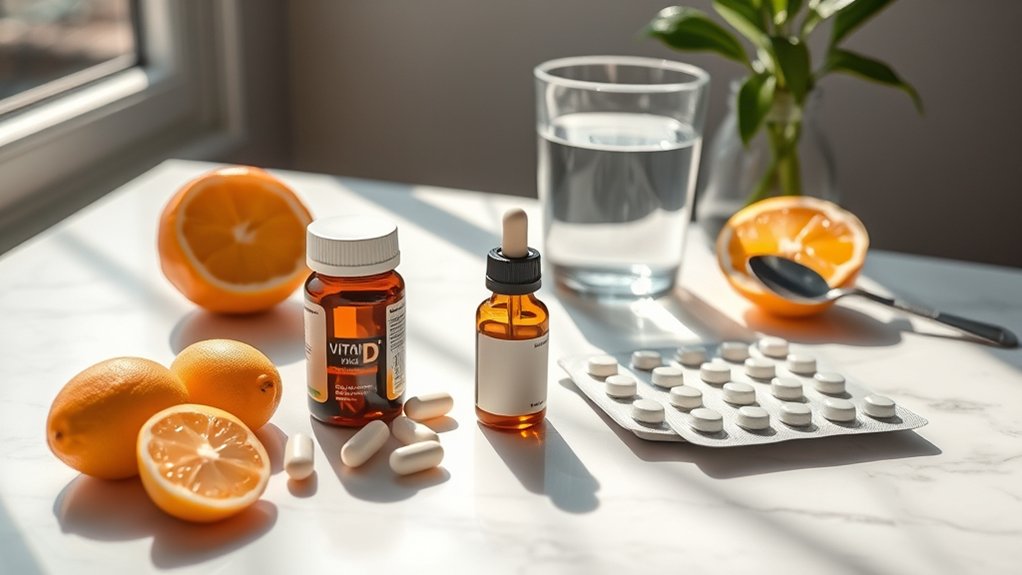
When you’re picking out a vitamin D supplement, it’s helpful to know the difference between D2 and D3. D3 tends to be more effective at boosting your vitamin D levels.
Also, how well your body absorbs the supplement can change depending on the form you choose—like soft gels or liquid drops.
Keeping these points in mind makes it easier to find the best option that fits your needs.
Vitamin D2 Versus D3
Although vitamin D supplements come in two main forms, D2 (ergocalciferol) and D3 (cholecalciferol), you’ll find that D3 is generally more effective at raising and maintaining your serum 25(OH)D levels.
D3 is naturally produced in your skin from sunlight and is more potent. It requires a lower dosage to achieve the same effect as D2.
For long-term supplementation, D3 is preferred because it has a longer half-life in the bloodstream. Both forms can meet the recommended daily allowance, but D3 often provides better results.
Consider these points when choosing between D2 and D3 supplements:
- D3 is more effective at increasing serum 25(OH)D levels
- D3 has greater potency than D2
- D3 lasts longer in your bloodstream
- Both forms meet the recommended daily allowance
- D3 is ideal for long-term supplementation
Supplement Absorption Efficiency
Because vitamin D is fat-soluble, your body absorbs it more efficiently when you take supplements with meals containing healthy fats.
Choosing the right form matters: vitamin D3 (cholecalciferol) is more effective than D2 (ergocalciferol) at raising and maintaining serum 25(OH)D levels. To meet the recommended daily allowance, which is 600 IU for most individuals, taking D3 with dietary fats enhances absorption.
Be aware that certain health conditions and medications can impair vitamin D absorption. So, consulting a healthcare provider for personalized recommendations is essential.
While about 28% of people supplement vitamin D, older adults often require adjustments due to reduced absorption efficiency.
Ultimately, optimizing supplement absorption depends on form selection, timing with meals, and addressing individual health factors. It’s all about finding what works best for you.
Best Time and Method to Take Vitamin D
Taking vitamin D supplements with one of your daily meals, especially those containing fat, greatly improves absorption because vitamin D is fat-soluble.
For ideal effectiveness, the best time to take vitamin D is in the morning or with breakfast, aligning with your body’s natural rhythms. Consistency matters, so try to take your supplements at the same time every day to maintain steady serum levels.
Remember, the recommended daily allowance varies: adults generally need 600-800 IU, while children 1 year and older require 600 IU.
It’s wise to consult a healthcare provider for personalized advice.
- Take supplements with a fat-containing meal
- Aim for morning or breakfast intake
- Maintain daily consistency
- Follow the recommended daily allowance
- Get personalized dosing from your healthcare provider
This method enhances vitamin D absorption and effectiveness.
How to Combine Vitamin D With Food and Sunlight

To get the most out of your vitamin D, try to spend about 5 to 30 minutes in the midday sun. It’s a great way to boost your levels naturally.
Along with that, including foods like fatty fish, egg yolks, and fortified products in your meals really helps.
When you take vitamin D supplements, it’s best to have them with meals that contain healthy fats. Since vitamin D is fat-soluble, this makes it easier for your body to absorb.
Optimal Sun Exposure
While sunlight is a powerful source of vitamin D, you need just 5 to 30 minutes of exposure between 10 a.m. and 4 p.m., depending on your skin type and location, to stimulate adequate synthesis.
Ideal sun exposure helps your skin make sufficient vitamin D from sunlight, supporting overall health. Keep in mind that sunscreen blocks UVB rays, so allow some time before applying it.
If you have limited sunlight access or during winter, consider a daily supplement of 600 IU. Pairing sunlight with dietary sources guarantees balanced vitamin D levels.
Aim for midday sun between 10 a.m. and 4 p.m.
Expose arms and legs for 5 to 30 minutes
Apply sunscreen after initial sun exposure
Take 600 IU supplement if sunlight is scarce
Complement sun exposure with vitamin D-rich dietary sources
Vitamin D Food Sources
Getting vitamin D from sunlight sets a strong foundation, but adding dietary sources helps keep your levels steady all year long.
You can boost your vitamin D intake by including fatty fish like salmon, mackerel, and sardines in your meals. These are rich, natural food sources.
Fortified foods, like milk and breakfast cereals, also contribute a lot to your daily value. For adults and kids over 4, this is 20 mcg (800 IU).
Since sun exposure changes with the season and your skin type, relying only on sunlight mightn’t cut it.
For breastfeeding infants and people who don’t get enough vitamin D from food, supplements are often needed to prevent deficiency.
Timing Supplements With Meals
Because vitamin D is fat-soluble, your body absorbs it best when you take supplements with a meal containing healthy fats. Pairing vitamin D supplements with foods like avocados or fatty fish enhances absorption, boosting serum levels effectively.
Consistency matters, so take your supplements at the same time daily with a meal. For ideal synthesis, aim for 15 to 30 minutes of midday sun exposure to naturally produce vitamin D. Taking supplements shortly after sun exposure maximizes overall vitamin D status.
- Take vitamin D supplements with meals rich in healthy fats
- Include foods like fatty fish or avocado for better absorption
- Maintain consistent supplement timing daily to stabilize serum levels
- Get 15 to 30 minutes of midday sun exposure for natural vitamin D synthesis
- Supplement soon after sun exposure to enhance vitamin D status
How to Adjust Vitamin D Based on Age and Health
Since vitamin D needs vary a lot across different life stages and health conditions, it’s important to adjust your supplementation accordingly.
Infants need 400 IU daily because breast milk doesn’t provide enough. Children over one year require 600 IU to support their bone health and immune function.
Infants need 400 IU daily, while children over one year require 600 IU for healthy growth.
Adults up to 70 years should aim for 600-800 IU daily to keep their bones strong and prevent deficiencies.
If you’re over 70, increasing to 800 IU daily is a good idea since skin synthesis and absorption slow down with age.
Also, if you have specific health conditions like obesity or malabsorption disorders, you might need higher doses.
In these cases, it’s best to talk to your healthcare provider so you can get personalized vitamin D advice that fits your unique health needs.
Vitamin D Deficiency Symptoms and Testing
How do you recognize vitamin D deficiency before it leads to serious health problems?
Vitamin D deficiency symptoms often include muscle weakness, fatigue, and depression.
In severe cases, adults may develop osteomalacia, and children can suffer from rickets. Since this is a global health issue affecting about 1 billion people, understanding testing is essential.
A blood test measuring serum 25-hydroxyvitamin D levels is the gold standard. Levels below 30 nmol/L indicate deficiency, while 30-50 nmol/L suggest inadequacy.
You don’t need routine testing unless you have risk factors like dark skin or limited sun exposure.
Watch for these symptoms:
- Persistent fatigue
- Muscle weakness
- Bone pain
- Mood changes like depression
- Frequent infections
Testing helps confirm if your levels are inadequate and guides supplementation.
How to Avoid Vitamin D Overdose Safely
While correcting low vitamin D levels is important, it’s equally important to avoid taking too much. To prevent overdose on vitamin D, stay within safe limits: adults and teens (11-17) shouldn’t exceed 100 mcg (4,000 IU) daily, children 1-10 years 50 mcg (2,000 IU), and infants under 12 months 25 mcg (1,000 IU).
Prioritize dietary sources and sunlight before supplements. Use supplements only if you’re at risk of deficiency. Regularly monitor your serum 25(OH)D levels to guarantee your vitamin D intake remains safe.
Be alert for symptoms of overdose, such as nausea, increased thirst, and confusion. These may signal serious health issues like hypercalcemia.
Always consult your healthcare provider before increasing doses or starting high-dose supplements to effectively prevent overdose and maintain ideal vitamin D status.
How to Make Vitamin D Supplementation Part of Your Daily Routine
Establishing a consistent vitamin D supplementation routine can help you maintain ideal levels year-round, especially when natural sunlight is scarce.
To make vitamin D part of your daily habits, consider these practical steps:
Take a vitamin D supplement of 600 IU daily, but you might want to adjust the dosage if you have specific health conditions.
Also, try to include vitamin D-rich foods like fatty fish, egg yolks, and fortified products in your meals.
Setting a daily reminder to take your supplements at the same time can really help build consistency.
It’s a good idea to schedule periodic blood tests to monitor your vitamin D levels.
This way, you can avoid both deficiency and overdose.
And of course, always consult your healthcare provider to tailor your vitamin D dosage and make sure you’re getting enough.
Frequently Asked Questions
Can Vitamin D Supplements Interact With Other Medications?
Yes, vitamin D supplements can interact with various medications. You need to carefully consider these medication interactions because they may affect calcium absorption and blood pressure.
For example, some drugs influence hormonal balance or cholesterol levels, while others can impact how well antidepressants work.
If you have autoimmune diseases, the nutrient synergy between vitamin D and your medications is especially important.
Always check with your healthcare provider before starting vitamin D supplements. This helps avoid adverse effects and ensures your treatment works as well as possible.
Are There Any Side Effects From Long-Term Vitamin D Supplementation?
Yes, long-term effects of vitamin D supplementation can include symptoms of overdose like nausea and confusion if you exceed dosage recommendations.
Your tolerance levels vary with age and health conditions, so you should monitor blood tests regularly.
Balancing supplements with sunlight exposure and dietary sources helps maintain safe levels.
Always consider your specific health conditions and consult healthcare providers to avoid toxicity and guarantee you’re supplementing appropriately over time.
How Does Vitamin D Impact Immune System Function?
Like a conductor guiding an orchestra, vitamin D directs your immune response by activating cells that fend off infections and regulate inflammation.
When you face vitamin D deficiency, especially during seasonal variations with limited sunlight exposure, your risk of respiratory infections and autoimmune diseases rises.
Maintaining gut health also depends on this vitamin. Following supplementation guidelines helps restore balance, ensuring your immune system performs effectively and keeps inflammation in check.
It’s pretty amazing how such a simple nutrient plays a big role in keeping you healthy.
Can Vitamin D Supplementation Improve Mood or Mental Health?
Yes, vitamin D supplementation can support mood enhancement and mental wellness. It helps regulate serotonin levels, which influence emotional stability and cognitive function.
Many people notice depression relief and anxiety reduction, especially during seasonal affective periods when sunlight is limited.
While vitamin D isn’t a cure-all, maintaining adequate levels plays a significant role in supporting your mental health and reducing mood disorder risks over time.
Is Vitamin D Supplementation Necessary for People Living Near the Equator?
Before smartphones, you’d rely on sunlight exposure more than apps to track health.
If you’re living near the equator, you usually don’t need vitamin D supplementation thanks to ample UVB rays enhancing skin synthesis. However, factors like darker skin, climate effects, and seasonal changes can affect your levels.
It’s a good idea to incorporate dietary sources and monitor your vitamin D status regularly.
Health recommendations suggest tailoring your approach based on local diets and personal lifestyle.
Conclusion
Now that you know how to tailor your vitamin D intake to your unique needs, the next step might surprise you. It’s not just about popping a pill. It’s about timing, form, and monitoring your levels carefully to avoid risks.
Before you start or adjust your dose, consider testing and consulting a professional. Mastering this balance guarantees you reap the benefits safely. This way, your vitamin D routine becomes truly effective and personalized.